
"d?"
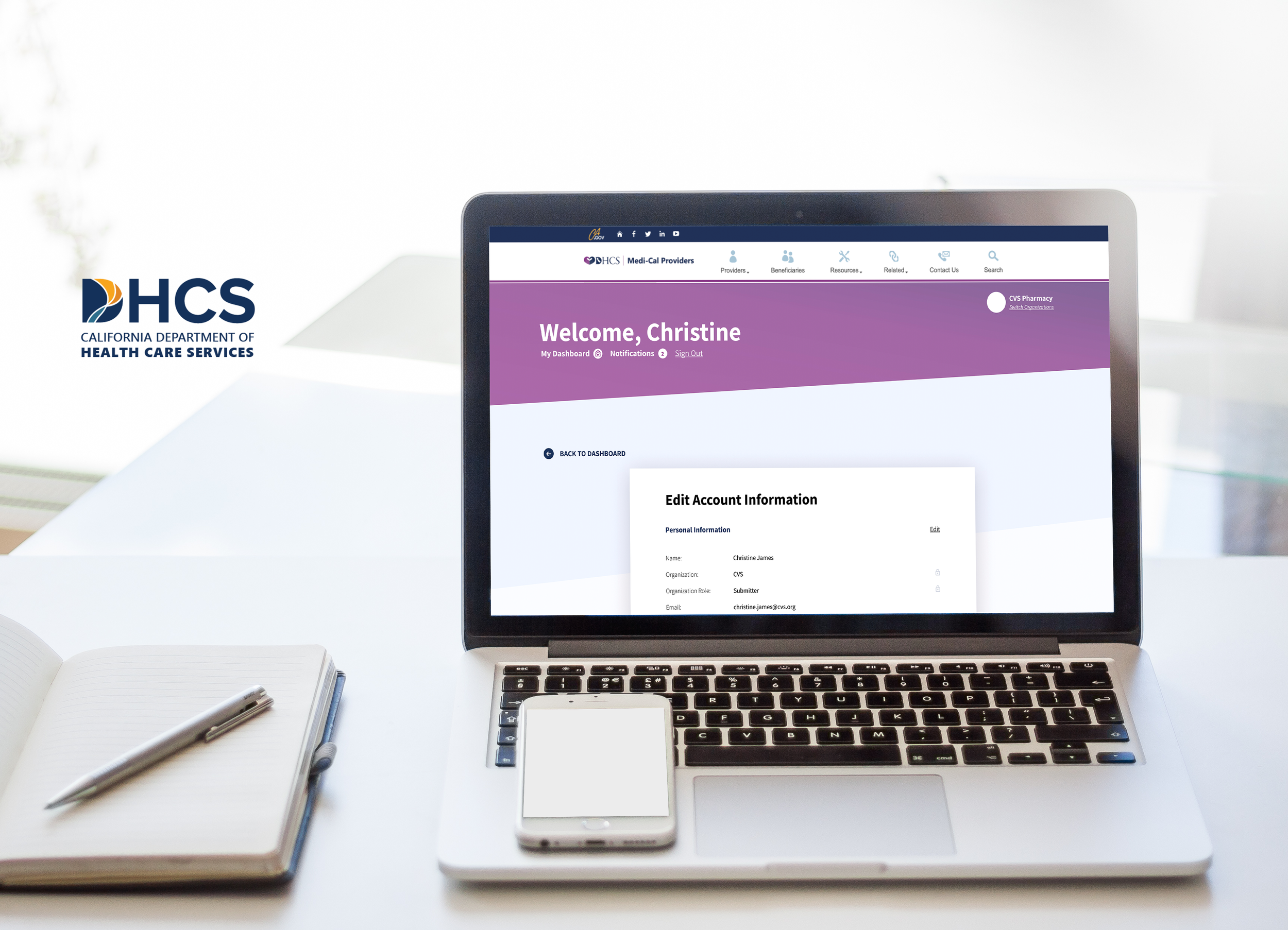
California Department of Health Care Services (DHCS)
Project Overview
CAMMIS DHCS Medi-Cal is a large-scale public healthcare platform used by providers across California to manage eligibility, enrollment, benefits, and transactional services for Medi-Cal members.
As part of a broader modernization effort, transactional services needed to be migrated into the main provider portal, requiring a redesign of complex transaction flows while maintaining regulatory compliance, usability, and operational stability.
This project focused on improving an existing government platform, improving clarity and consistency across 100+ screens used daily by providers and administrators.
About the Client
The California Department of Health Care Services (DHCS) administers Medi-Cal, California’s Medicaid program, serving millions of residents statewide.
The CAMMIS platform supports healthcare providers, health plans, and internal users by enabling eligibility checks, enrollments, benefit management, and transactional interactions.
Transactional workflows within CAMMIS had grown over time, resulting in fragmented experiences across multiple entry points and inconsistent patterns.
Key challenges included:
Migrating transactional services into the main provider portal
Large volumes of transactional screens with inconsistent layouts and logic
Ensuring scalability and maintainability across future releases
The goal was to redesign transaction flows to be clearer and more consistent, while preserving the integrity of the existing system.
The Challenge
As UX designer, I worked as part of a large, cross-functional UX team responsible for redesigning and migrating transactional services into the CAMMIS provider portal.
Designing end-to-end transactional workflows
Creating and maintaining high-fidelity UI designs across multiple squads
Establishing consistent patterns
Supporting design handoff and iterative delivery across phased releases
My Role
Transactional flows in CAMMIS involve multiple steps, validations, and edge cases that must be handled precisely.
Standardizing layouts and interaction patterns across transactions (by creating design system)
Improving information hierarchy to reduce cognitive load
Designing clear system feedback for errors, confirmations, and status changes
Ensuring accessibility and usability
This approach helped transform dense transactional screens into clearer, task-focused experiences
Design Approach
Structuring Transactional Complexity
Due to the scale of the platform, the work was distributed across multiple squads, each responsible for different functional areas.
I contributed design work across:
Squad 2 - Provider Portal: Focused on restructuring transactional entry points and navigating within the provider portal.
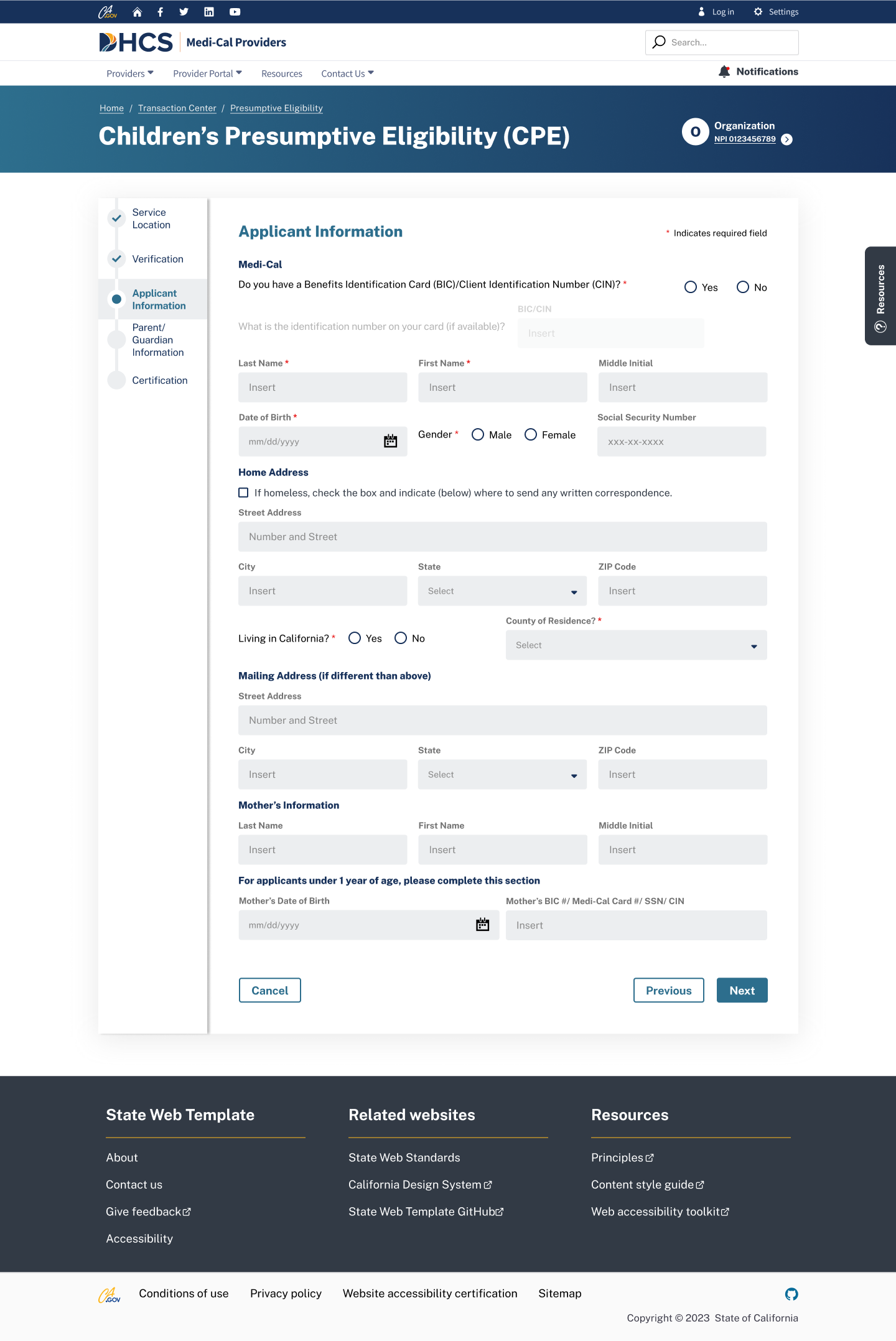
Squad 7 - Presumptive Eligibility: Designed workflows supporting eligibility determination, enrollment, and benefit verification.
Each squad required close coordination to maintain consistency across shared components and interaction patterns.
Designing Across Multiple Squads
To support long-term maintainability, the design effort emphasized pattern reuse and modularity.
I worked closely with other designers to:
Define reusable UI components and transaction templates
Align designs with existing design system guidelines
Ensure patterns could scale across 100+ transactional screens
This allowed the designers to design efficiently while maintaining a cohesive experience across all the squads.
Pattern-driven Design for Scale
The redesigned transactional experiences delivered:
Clearer, more consistent transaction flows across the provider portal
Improved usability for high-frequency provider tasks
Stronger alignment between UX, engineering, and accessibility requirements
A scalable foundation for future transactional enhancements
The work supported DHCS’s broader goal of modernizing Medi-Cal systems while ensuring reliable access for providers and members.