
Toyota Motors North America
Key Words: Multi-platform Ecosystem, Automotive, Configuration-based UX, Data-heavy Interface Design, Order Management, Figma
Toyota sells over 2 million vehicles annually in the U.S. and the internal systems that manage how those vehicles move from factory to dealer to customer had become a bottleneck. TMNA's goal was to rebuild their entire end-to-end supply chain, designing a new system from scratch that met and exceeded customer experience requirements, not just to uplift a technology, but also to rethink fundamentally how vehicle distribution works. I was embedded in that transformation as the Senior UX Designer owning two of its most operationally critical platforms.
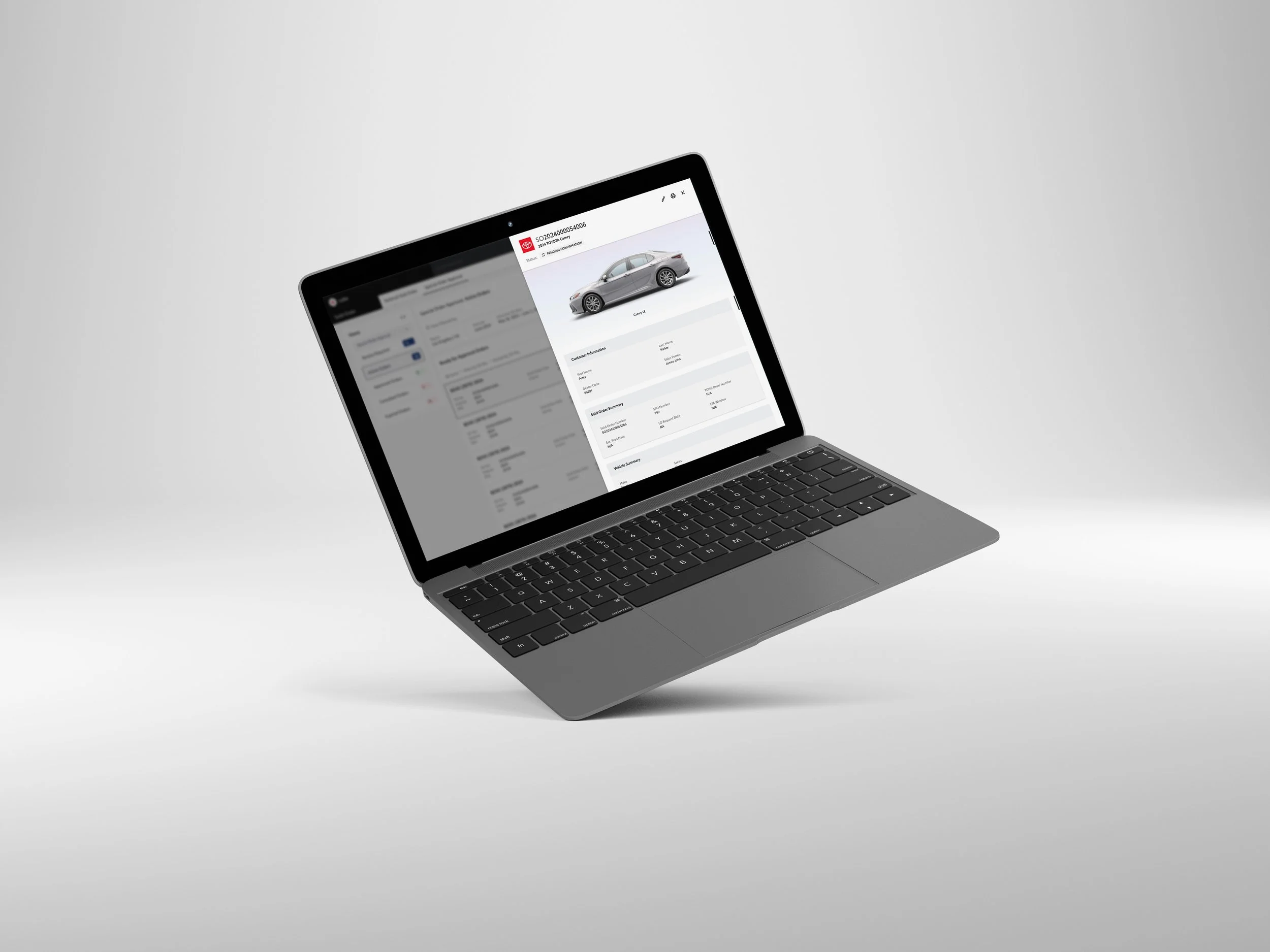
Toyota Motors North America (TMNA) Cube (An internal tooling supporting vehicle configuration, ordering, and fulfillment across dealer and operations networks in the U.S. and Canada)
Client
1,200+ Toyota dealers and 200+ Lexus dealers across North America
Scale
My Role
Senior UX Designer
Tools
Figma
IBM design team of 7+ designers each owning different platforms within the TMNA ecosystem
Team
National Sold Order (NSO) and Smart Fulfillment Engine (SFE), with advisory contributions to Dealer Daily
My Platforms
Duration
Mar 2024 - Oct 2024
Real Problem (a.k.a. the challenge)
Toyota had been running their supply chain on an old system that needed technology uplifts, but rather than just modernizing the tech, the decision was made to rebuild with customer experience as the guiding light, ensuring every design decision was driven by what a customer would want.
For the internal teams and dealers using NSO and SFE daily, this created a significant design challenge:
The existing platforms had grown to accommodate expanding vehicle programs and business rules, but without a unified design foundation, resulting in dense, inconsistent interfaces that were difficult to act on quickly
NSO managed the full lifecycle of national sold orders across the dealer network, and errors in this flow had direct downstream consequences on vehicle availability and customer delivery timelines
SFE handled the fulfillment logic connecting orders to production and distribution, a system where clarity and accuracy weren't just UX goals but operational requirements
The broader transformation goal was to help customers pick the best vehicle for them individually, predict ETAs accurately, and create a system flexible enough to treat each customer as an individual, which required the internal tooling to be just as thoughtful and precise
Constraints
Operational continuity: NSO and SFE were in active daily use across 1,200+ dealer locations, so any changes had to be introduced without disrupting live workflows
Cost minimization: The brief required improvements through configuration and refinement, not net-new engineering, meaning designs had to evolve existing patterns wherever possible
High accuracy requirements: The supply chain had to deal with parts limitations, constrained resources, and the complexity of managing vehicle distribution at scale, where configuration errors in ordering or fulfillment had real operational and financial consequences
Speed of delivery: One of TMNA's core goals was pushing the speed at which new features got out without disrupting customer trust, so designs had to be ready for fast, iterative release cycles
Distributed team coordination: With 7+ designers owning separate platforms, maintaining consistency across the broader ecosystem required constant cross-team alignment
Design Decisions
Dealers and operations staff in NSO and SFE weren't occasional users. These hese were their primary work tools, used all day, every day. Every pattern they'd internalized represented real speed. Rather than introducing unfamiliar paradigms, I identified specifically where existing layouts broke down under real operational conditions, such as, dense data, status ambiguity, edge case handling, and addressed those precisely, preserving familiar scaffolding around them.
Evolving patterns, not replacing them
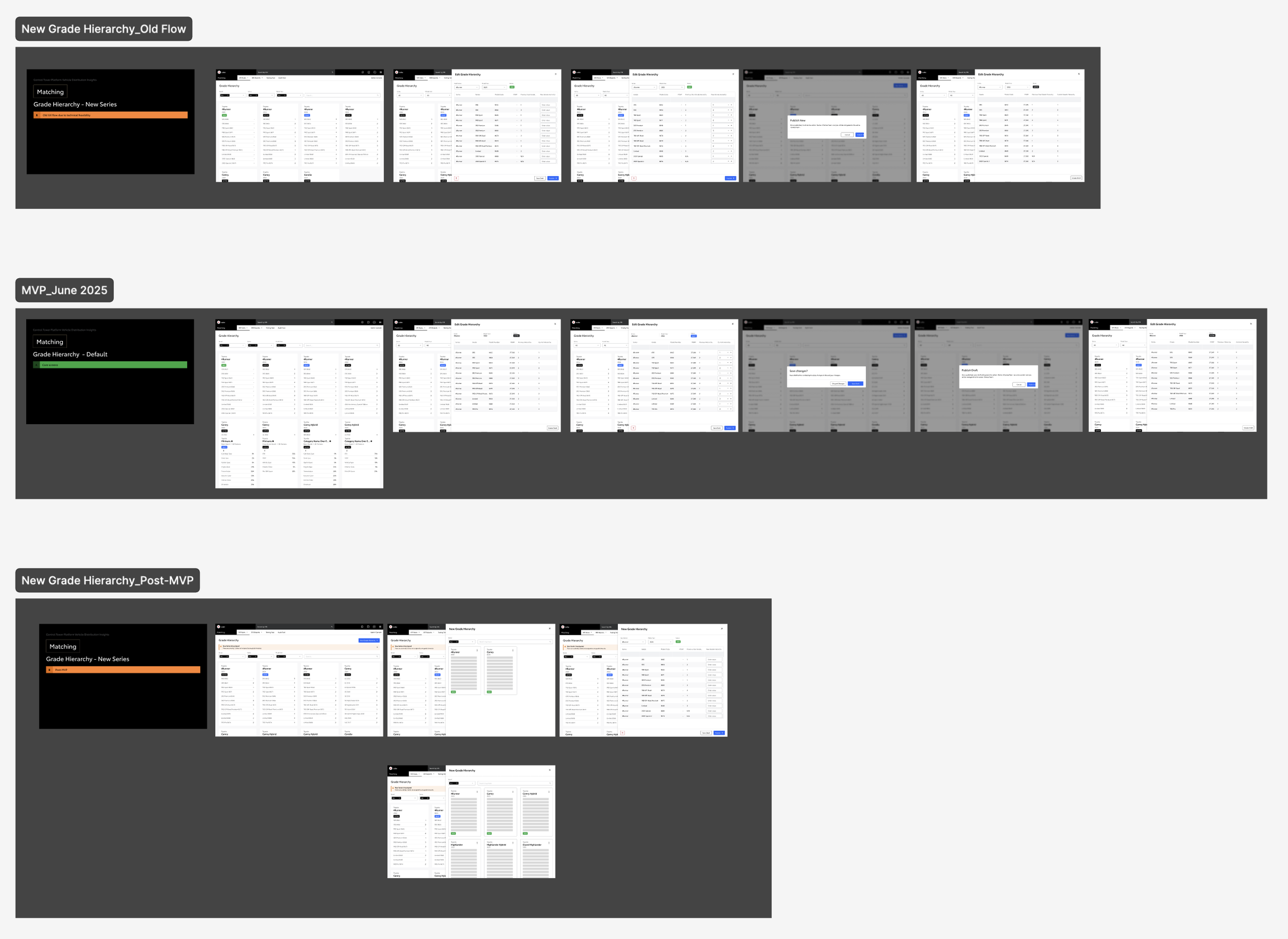
NSO and SFE surfaces were information-dense by necessity. Rather than simplifying by removing data, I restructured layouts to establish clearer visual hierarchy, surfacing action-critical order information first, grouping related fields logically, and making status immediately readable at a glance. The goal was to make complexity navigable, not to hide it.
Hierarchy over reduction
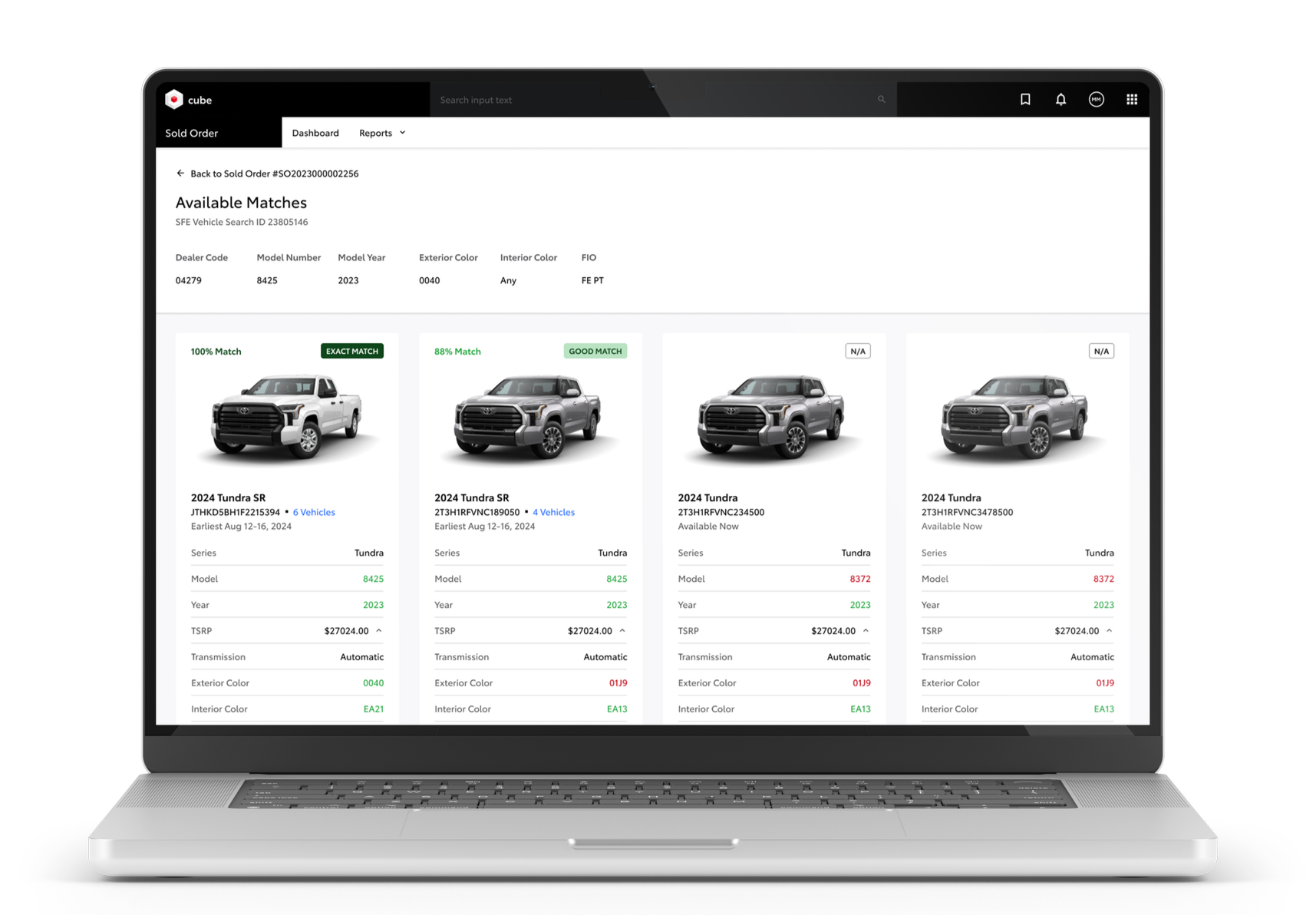
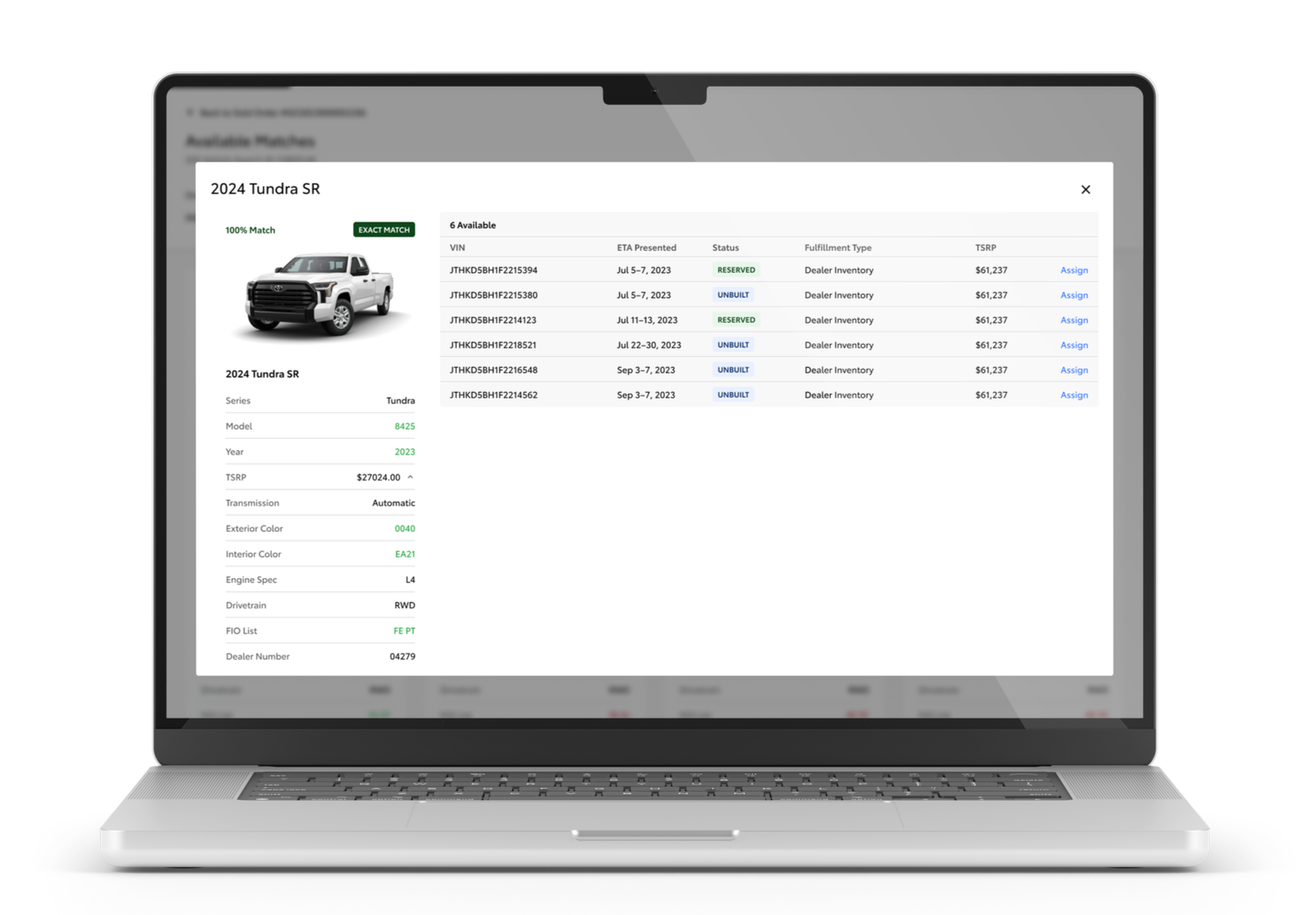
Designing for error prevention, not just recovery
Given the downstream consequences of configuration mistakes across a 1,200+ dealer network, I prioritized making the right action the obvious action, clear labeling, explicit confirmation patterns for high-impact actions, and inline validation that surfaced issues before submission rather than after.
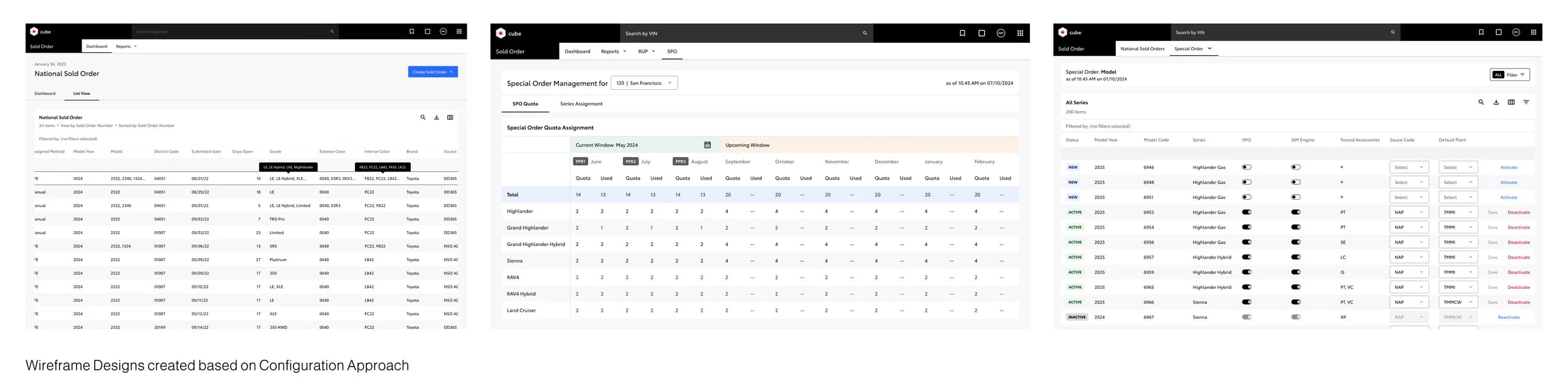
Aligning internal tooling with the customer-centric vision
IBM's approach was to embed together with Toyota teams, understanding the complexity of how work actually gets done, walking in the shoes of dealers and employees, mapping journeys and identifying pain points together in a room. My design decisions for NSO and SFE were grounded in that same principle that the dealer-facing tools had to support the customer experience goals at the top of the program, not just the operational requirements of the internal teams.
Real Impacts
Program scale:
Part of TMNA's multi-year end-to-end supply chain transformation, a program rebuilding the entire vehicle management and distribution system for a company selling over 2 million vehicles annually in the U.S.
UX delivered across NSO and SFE, platforms supporting vehicle ordering and fulfillment across 1,200+ Toyota and 200+ Lexus dealers
Distributed design team of 7+ designers coordinated across the broader TMNA Cube ecosystem
Design impact:
Reduced cognitive load and error risk across high-frequency operational tasks in NSO and SFE
Improved consistency across platforms through shared patterns and weekly cross-team design reviews
Advisory UX contributions to Dealer Daily ensured dealer-facing communication patterns aligned with internal tooling decisions
Delivered within engineering constraints, with all improvements achievable through configuration and pattern refinement, requiring no net-new infrastructure
I learnt…
TMNA was one of the most well-structured design teams I had worked with. What struck me most was how resilient the team was by design. The systems, processes, and documentation were built so thoroughly that the work could continue seamlessly even as team members rotated in and out. That was a tangible lesson in what good team infrastructure actually looks like in practice, and it shaped how I think about design systems and team building beyond just the artifacts themselves.
Coming into a domain I had never worked in before was its own kind of challenge. Automotive has its own language, vehicle types, fulfillment terminology, abbreviations that everyone on the client side treated as common knowledge. The early weeks involved as much learning the domain as designing within it. But that process of decoding a new industry from scratch, building enough fluency to ask the right questions and make informed design decisions, is one of the things I've come to value most about working in consulting. Every project is an opportunity to become conversant in a world you didn't know before.
The most formative tension on this project was navigating a stakeholder environment where design wasn't always prioritized. The project was led with a strong emphasis on cost and configuration constraints, which sometimes meant design rationale had to be fought for rather than assumed. I learned to come to every key decision point with two or three design options, each grounded in user needs but framed in the language of feasibility and trade-offs. That discipline, making the case for good design in terms that resonate with non-design stakeholders, is something I carry into every project now.